
Kent County Juvenile Detention Overview
The Kent County Juvenile Detention Center is operated by Kent County through the Circuit Court Family Division context, not as part of the adult sheriff jail roster. The official county page describes it as a secure residential facility for juveniles who cannot be placed in a less restrictive setting. Youth are held in pre-disposition or post-disposition short-term care and custody. The page states that all youth accepted into the residential program have been court ordered.
The center serves young people who are awaiting court-ordered placement, have violated the law, have violated court orders, or have violated probation conditions. It can also hold youth pending court study, disposition, transfer to another jurisdiction or agency, or other court action when secure custody is required. That means a juvenile detention placement is driven by Family Division orders and case-specific needs, not by a public adult booking search.
The county page identifies a secure setting with ten units, including three units reserved for county-based residential programs and one secure housing unit for higher-risk youth. Capacity is listed at 98 beds. The official page also names the superintendent as Huemartin Robinson and gives a daily closure for shift change from 2:15 to 3:00 pm. Those facts help identify the facility, but they do not create a public roster.
The county juvenile page is the proper image source for this facility because it shows the public county description of the detention center rather than an adult jail lookup.
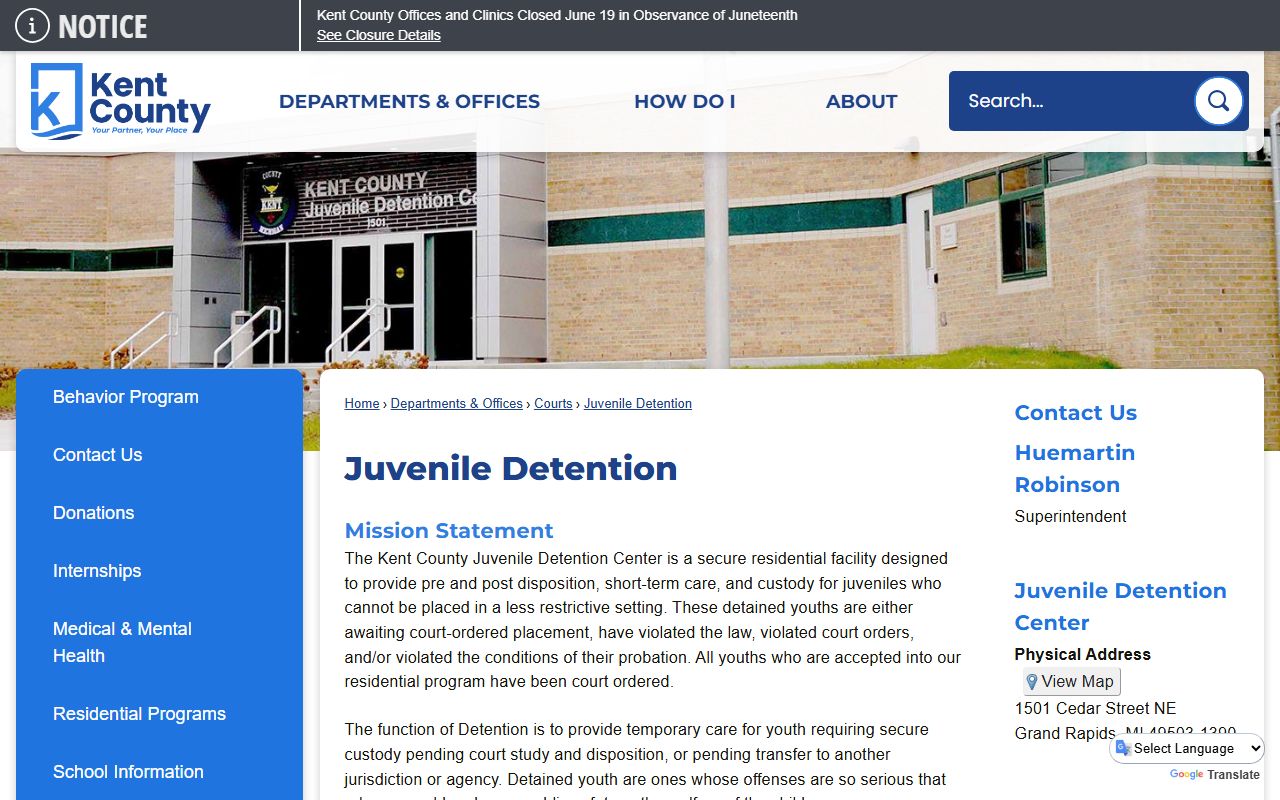
The image supports the facility-specific discussion because it comes from the official juvenile detention page and reflects the separate juvenile custody channel.
Kent County Juvenile Custody Limits
Kent County Juvenile Detention Center should not be treated like Kent County Correctional Facility. No official public juvenile roster, mugshot gallery, or booking search was located in the reviewed county sources. The adult Web Jail Viewer is built for adults booked into KCCF and can show adult booking numbers, custody labels, charges, bond fields, and booking photos when the facility makes them public. Juvenile proceedings and detention records are more restricted, and public adult search practices do not carry over to youth custody.
That distinction protects youth and avoids routing families to the wrong system. A parent, guardian, attorney, or other authorized person should work through the Family Division, the assigned probation or case worker, the facility, or the attorney of record. A person who is not legally entitled to information may not receive confirmation just because the adult jail has a public lookup tool. The right question is not whether a youth appears on the adult roster, but which court order, case worker, or facility contact controls communication for that youth.
Important: Adult Web Jail Viewer is not a juvenile detention search tool. Use court and authorized contact channels for youth custody questions.
Kent County Juvenile Beds
The official county source lists the Kent County Juvenile Detention Center capacity as 98 beds. The bed count is not the same as an adult average daily population, and the research did not locate a current public juvenile daily-population table comparable to the 2025 annual report for the adult jail. The documented bed capacity is the supported figure; no daily count, annual admissions count, or demographic breakdown for youth in secure detention was located in the reviewed source set.
Several parts of the program description explain what the bed count supports. Three units are reserved for county-based residential programs, and one secure housing unit serves higher-risk youth. Detention is temporary care for youth who need a secure placement while the court studies the case, reaches disposition, or arranges transfer. Residential programming is also court ordered, so the youth population can include both pre-disposition and post-disposition short-term custody.
Kent County Juvenile Custody Search
A Kent County Juvenile Detention Center custody question should begin with relationship and authority. A parent or guardian may need to contact the facility, the juvenile court, or the assigned probation or case worker. An attorney should use attorney-client and court channels. A member of the general public should not expect a public record result like an adult booking detail. The official research found no public juvenile booking index, no juvenile mugshot display, and no online public roster tied to this facility.
- Confirm whether the person is a juvenile case, an adult jail case, or a state, federal, or immigration custody matter.
- For a youth case, use the Family Division or assigned case worker instead of Web Jail Viewer.
- Call the Kent County Juvenile Detention Center at 616-632-5750 if the question concerns facility contact, visitation, or approved communication.
- If the matter is an adult booking, use the Kent County Correctional Facility roster instead.
- For court orders or case status, use the appropriate juvenile court or attorney channel rather than public adult jail search tools.
The adult and juvenile systems can touch the same county government, but they answer different legal questions. Adult roster data focuses on booking, charges, bond, custody status, and public jail records. Juvenile detention focuses on court-ordered secure care, school, behavior programming, health screening, and Family Division case handling. Linking the two too closely can mislead readers, especially when a family is trying to locate a youth or understand a court placement.
Kent County Juvenile Contact
The official contact block gives the facility address, main phone, and fax number. The facility is on Cedar Street NE in Grand Rapids, separate from the Ball Avenue adult jail campus. The page also says the facility is closed daily for shift change from 2:15 to 3:00 pm. Anyone planning a visit or trying to reach approved staff should account for that daily closure and should confirm whether they are authorized to receive or discuss information.
Kent County Juvenile Detention Center
1501 Cedar Street NE
Grand Rapids, MI 49503-1390
616-632-5750
Fax: 616-632-5758
Closed daily for shift change, 2:15-3:00 pm
Family Division Context
Kent County Circuit Court Family Division
Grand Rapids, MI
Use assigned case or court contact
For court-ordered juvenile placement issues
Because the youth are court ordered, the facility may not be able to discuss case details with every caller. Families should be ready to provide the youth's legal name, their relationship to the youth, the assigned case or probation contact if known, and the nature of the request. Attorneys should use the proper legal channel for case access and visitation questions.
Kent County Juvenile Visits
Visitation at Kent County Juvenile Detention Center is published on the county's juvenile detention page and is organized differently from adult jail visitation. The posted juvenile schedule separates detention visitation by last-name group on Sunday and Wednesday. Residential visitation and secure housing unit visitation have separate windows. These hours are facility-specific and should be confirmed before travel because youth status, court order, unit assignment, behavior status, or facility operations may affect access.
| Visit Group | Day | Hours |
|---|---|---|
| Detention, last names A-K | Sunday | 1-2 pm |
| Detention, last names L-Z | Sunday | 3:30-4:30 pm |
| Detention, last names A-K | Wednesday | 6-7 pm |
| Detention, last names L-Z | Wednesday | 7:30-8:30 pm |
| Residential visitation | Thursday | 7:30-8:30 pm |
| Residential visitation | Sunday | 10:30-11:30 am |
| Secure housing unit | Thursday | 6-7 pm |
Visitors should not assume that adult KCCF SmartInmate scheduling rules apply to the juvenile center. The juvenile page does not describe the adult Web Jail Viewer, adult SmartInmate video visits, adult mail rules, or adult tablet fees as the route for youth. Confirm the correct visit category, approval requirements, identification needs, and unit status with the juvenile facility or assigned case contact before arriving.
Kent County Juvenile Programs
The juvenile detention source describes programming built around a group-living model, behavior management, and Cognitive Behavioral Training. Those terms mean the facility is not just a holding area. Group living sets daily expectations within the unit. Behavior management uses structured rules and incentives. Cognitive Behavioral Training focuses on how thoughts, choices, and actions connect, which can be part of a court-ordered response for youth who need more structure than a less restrictive setting can provide.
School is a major part of the center. The county page says a full school program is a major component and that Lighthouse Academy funds and staffs the school division. This is an important difference from adult jail content. Youth in detention still need education services, and facility programming is shaped by age, court status, and placement needs. A public adult jail roster cannot explain those program details or tell a family what a youth's school plan is.
- Pre-disposition
- Custody before the juvenile court reaches a final decision or placement order.
- Post-disposition
- Short-term custody after the court has made a decision or ordered a program placement.
- Secure housing unit
- A more controlled unit used for higher-risk youth described by the county source.
- Cognitive Behavioral Training
- Programming that works on thought patterns, choices, and behavior.
Kent County Juvenile Health
The county juvenile detention page states that medical staff examine juveniles within 24 hours of admission. Nursing staff are on duty from 7 am to 10 pm daily, and clinic doctors see youth twice weekly. Network180 provides on-site crisis intervention and assessments at all hours. These health facts are central to the facility description because youth in secure detention may arrive with urgent physical, mental-health, school, family, or safety needs.
| Service | Published Detail | Facility Role |
|---|---|---|
| Admission medical exam | Within 24 hours | Initial health screening after arrival |
| Nursing | 7 am-10 pm daily | Daily health support |
| Clinic doctors | Twice weekly | Scheduled clinical care |
| Network180 | On-site crisis intervention and assessments 24/7 | Mental-health and crisis response |
Health and crisis details are not public proof of a particular youth's condition. They describe the facility's published service structure. A parent, guardian, or attorney seeking case-specific information should use approved communication channels and be prepared for privacy limits.
Juvenile Center vs Adult Jail
The Kent County Juvenile Detention Center and Kent County Correctional Facility serve different populations. KCCF is the adult jail. It is run by the sheriff, uses Web Jail Viewer, and publishes adult roster details when configured by the facility. The juvenile center is for court-ordered youth who need secure care or residential programming and cannot be placed in a less restrictive setting. Treating the juvenile center as a second adult jail would be inaccurate.
| Question | Adult KCCF | Juvenile Detention Center |
|---|---|---|
| Who is held? | Adults in sheriff custody | Court-ordered youth |
| Public roster? | Web Jail Viewer for adults | No public juvenile roster located |
| Primary legal context | Arrest, booking, bond, local sentence | Family Division and juvenile court orders |
| Facility address | 703 Ball Avenue NE | 1501 Cedar Street NE |
A Kent County adult inmate search belongs with the sheriff's KCCF roster and inmate information line. A youth-custody question belongs with the juvenile facility, Family Division, the assigned case worker, or counsel. The distinction is especially important when a family has only a name and a rumor of custody. For adult custody at the Ball Avenue jail, the Kent County Correctional Facility page explains the roster, visitation, bond, mail, and records channels.
Kent County Juvenile Records
Juvenile detention records should be handled with more care than adult booking records. The research did not locate a public juvenile booking-photo page, an online roster, or a public search form for youth held at the Kent County Juvenile Detention Center. Adult FOIA rules and public jail-record practices do not mean every juvenile record is public or that a youth's location will be confirmed to every caller.
When a record question exists, start with the authority connected to the youth's case. That may be the Family Division, the assigned probation officer, an attorney, or the facility contact. If a request is not case-specific and concerns county records generally, Kent County has a FOIA process, but exemptions and confidentiality rules may limit what can be released. The safest wording for this facility is that no adult-style public roster was found and that authorized parties should use court and facility channels.
Note: Confirm visit approval and information-access rules with the juvenile facility or assigned court contact before relying on any schedule or custody detail.